bluename
How to Set Hanging-Basket Horizontal Spacing for Good Rose-Foliage Airflow
Getting hanging-basket horizontal spacing right is the single most useful thing I ever did for my roses. Not fertilizer. Not fancy pruning shears. Spacing. Here's the short answer up front: for most compact and patio roses grown in hanging baskets, leave at least 18 to 24 inches of clear air between the outer rims of neighboring baskets. If your roses are prone to black spot or you live somewhere humid, push that to 30 inches. That gap is what lets air move through the foliage instead of sitting on it.
I learned this the hard way.

Two summers ago I hung six miniature roses along a south-facing porch rail because it looked full and lush in my head. Three weeks later, half of them had black spot, and the leaves in the middle of each basket were yellow and dropping. I'd created a wall of wet leaves with zero airflow. That's when I started actually measuring instead of eyeballing.
Why Horizontal Spacing Matters More Than You Think
Rose foliage stays healthy when it dries off quickly after rain or watering. When baskets sit too close, the leaves trap moisture between them. Fungal spores love that. Black spot, powdery mildew, rust — they all get a free ride.
The RHS is pretty blunt about this: good air circulation around roses reduces disease pressure more reliably than most sprays. And the AHS makes the same point from the growing side — crowded plants compete for light and air, and the weaker ones lose.
So spacing isn't cosmetic. It's disease prevention.
The Numbers I Actually Use Now
After killing more than a few rose baskets, here's the spacing I've settled on:
- Compact patio roses (like 'Spicy' or 'Sunny Knock Out'): 18 inches rim to rim
- Miniature roses: 12 to 15 inches
- Full-size shrub roses in large baskets: 24 to 30 inches
- Any rose with known black-spot issues: add 6 inches to whatever you'd planned
I also stagger the heights. If one basket hangs at 5 feet and the next at 6 feet, the air moves between them diagonally instead of hitting a flat wall. Sounds fussy. It works.
My 2-Week Spacing Test
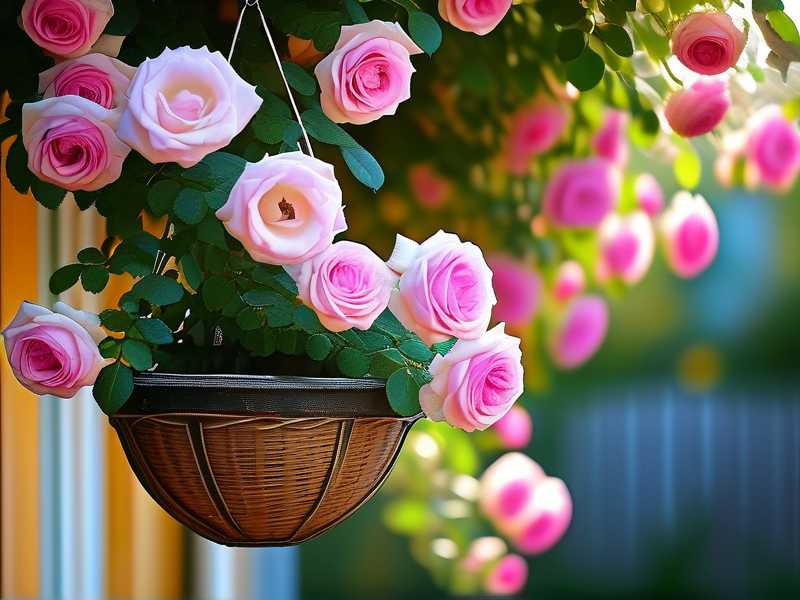
I ran a simple comparison last June. Two rows of miniature roses, same cultivar, same soil mix, same watering schedule.
Row A: baskets spaced 10 inches apart. Row B: baskets spaced 22 inches apart.
Day 1 to 4: no visible difference. Everything looked fine.
Day 5 to 7: Row A leaves started staying wet longer after my morning watering. Row B dried within about an hour.
Day 8 to 10: first black spot spots appeared on three plants in Row A. Nothing on Row B yet.
Day 11 to 14: Row A had obvious leaf drop in the center of each basket and two plants were clearly stressed. Row B stayed clean, and new growth looked stronger.
That two-week window told me everything. Ten inches felt "close enough" and it wasn't even close.
How to Measure Spacing Without Losing Your Mind
You don't need a laser level. Here's what I do.
- Hang the first basket where you want it.
- Hold a tape measure from the outer edge of that basket to where the next basket's outer edge would land.
- Mark the spot with a piece of painter's tape on the rail or hook.
- Hang the next basket on that mark.
If you're using a bracket system, measure hook center to hook center, then subtract the basket diameter. That gives you the clear gap. I messed this up the first time — I measured hook to hook and forgot the baskets themselves were 14 inches wide. Ended up with almost no gap at all.
The Three Mistakes That Kill New Growers
I've made all three. You probably will too if nobody warns you.
Mistake 1: Overwatering. This is the big one. 90% of indoor plants die from overwatering, and hanging roses are no exception. People see drooping leaves and reach for the can. But drooping can mean too wet, not too dry. Stick a finger in the soil. If it's soggy two inches down, don't water. Spacing and watering are connected — crowded baskets dry slower, so you water less, so the soil stays wet, so the roots rot. It's a loop.
Mistake 2: Wrong light placement. Roses want sun. Hanging them under a porch overhang because that's where the hooks are is a recipe for weak growth and disease. I did this with two baskets and the plants stretched toward the light and got leggy. Then the crowded, shaded foliage stayed damp. More spacing plus more sun solved it.
Mistake 3: Wrong pot or basket. Small baskets dry out too fast and large ones stay wet too long. A 12-inch basket for a miniature rose is about right. A 10-inch basket for a full shrub rose is a death sentence. I tried it once. The roots circled, the plant stalled, and by August it was gone.
Long-Tail Details That Actually Matter
Airflow direction. Don't just think gap size. Think about which way the wind blows. On my porch, the prevailing breeze comes from the west. So I space a little wider on that side and let the air enter the row. If your baskets are against a solid wall, you need more spacing, not less, because air can't escape behind them.
Staggered rows. If you hang two rows, offset them. Put the second row's baskets in the gaps of the first row. This breaks up the "wall" effect and lets air pass through.
Pruning inside the basket. Even with perfect spacing, a dense center is a problem. I thin out the middle of each rose basket every two weeks — just snip a few inward-facing leaves and weak stems. More open center, more airflow.
Watering technique. Water in the morning, at the soil, not the leaves. Wet foliage plus tight spacing equals disease. I switched to a long-spout watering can so I could reach the soil without splashing.
Humidity and climate. If you garden in the American South or coastal UK, you already fight humidity. Go wider on spacing. If you're in a dry climate like Arizona or inland Australia, you can go a bit tighter because the air dries leaves fast.
Common Questions I Get From Other Growers
How do I know if my spacing is too tight? Watch the leaves in the middle of each basket. If they stay wet for more than an hour or two after rain or watering, you're too tight. If you see black spot starting in the center rather than the edges, that's another sign.
Can I fix spacing after the baskets are already hung? Yes. Just move them. I've re-hung baskets mid-season more than once. The plants don't care. It's better to fix it than to watch them decline.
Does spacing matter as much in winter? Less, because growth slows and humidity is lower. But if you overwinter roses indoors or in a greenhouse, keep the spacing. Damp, still air in a closed space is worse than outdoor humidity.
What about vertical spacing? Also matters. Leave at least 12 to 18 inches between the bottom of one basket and the top of whatever is below it. Air needs to move up and out, not just sideways.
Wrapping This Up
If you take one thing from all of this, make it the number. Measure your gap. Don't guess. Eighteen to 24 inches for most hanging roses, wider if you're in a humid spot or your plants have a history of disease.
I spent two seasons learning this the expensive way. You don't have to. Hang them, measure, adjust, and then leave them alone. The airflow does the rest.