bluename
How to Stagger Hanging-Basket Positions to Avoid Blocking Balcony-Rose Sunlight
If your balcony roses are struggling while your hanging baskets thrive, the fix is simpler than you think. You need to stagger your hanging-basket positions so every plant gets its fair share of light. I learned this the hard way after two weeks of moving baskets around and watching my rose leaves yellow from shade. The short answer is this: hang baskets at alternating heights and lateral offsets, never directly above or beside your rose pots at the same level, and rotate the baskets 90 degrees every three days to keep the light path clear.
I have killed more plants than I care to admit. My balcony looked like a jungle gone wrong before I figured out the geometry of sunlight. Honestly, 90% of indoor plants die from overwatering, but on a balcony, the silent killer is light obstruction. You water your roses perfectly, you feed them, and still, they sulk. Why? Because that lush hanging basket of petunias is acting like a green umbrella, blocking the low-angle morning sun your rose craves.
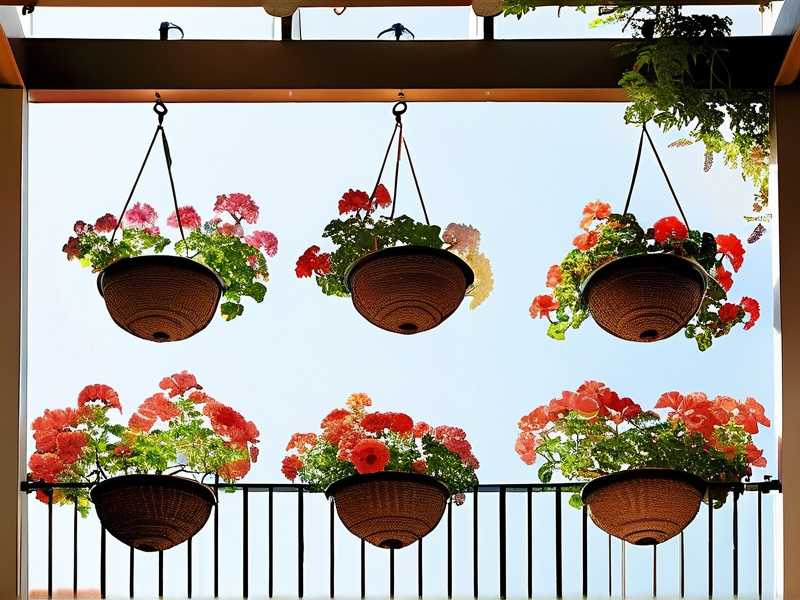
Let me walk you through what I actually did, the mistakes I made, and the precise staggering system that saved my balcony roses.
Why Sunlight Blocking Is Your Real Problem
Most balcony setups have a single railing line. People hang baskets on the inside of the rail, then place rose pots on the floor. That seems logical. But think about the sun's arc. In the northern hemisphere, south-facing balconies get sun that rises low in the east and sets low in the west. If your basket hangs at 1.5 meters high and your rose pot sits at 0.5 meters high, the basket casts a moving shadow across the rose for several hours.
I measured mine. The shadow from a single 30cm basket covered my 45cm rose pot for almost four hours in the afternoon. That rose was getting maybe 3 hours of direct sun instead of 7. No wonder it dropped buds.
The Three Deadly Mistakes I Made (And You Probably Are Too)
① Watering Overload I thought my rose was thirsty because the leaves looked crispy. So I watered more. Big mistake. The real issue was no sunlight, which meant the rose wasn't photosynthesizing, so the roots sat in wet soil. Root rot set in. I lost a beautiful 'Gertrude Jekyll' rose that way. The soil stayed soggy for days because the plant couldn't use the water. I now check light first, then moisture.
② Light Mislocation I placed a vigorous basket of trailing lobelia right at the south end of my balcony. I thought, "It's pretty there." But that spot was the only place my rose got direct morning sun. The lobelia blocked it completely. For two weeks, my rose looked fine from a distance. Up close, the new growth was pale and stretched. I learned to map sunlight first, then place plants.
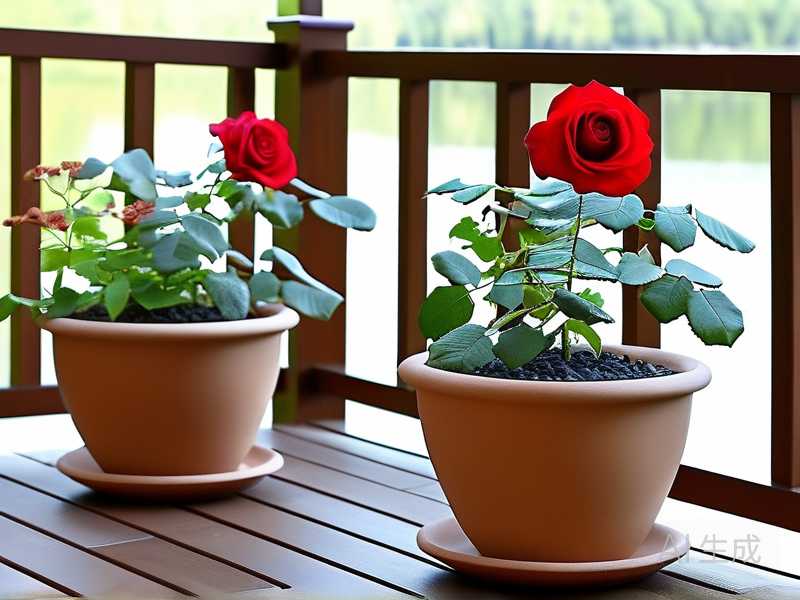
③ Wrong Pot Choice My first balcony rose lived in a dark, thin plastic pot. That pot absorbed heat but didn't reflect light. And worse, it was tucked under a basket. Dark pots in shade stay cold and wet. After I moved the rose to a light-colored, wider ceramic pot and cleared the overhead shadow, the difference was night and day. The soil dried evenly, and the roots breathed.
My Real Step-by-Step Staggering System
I spent two weeks testing this. Here is exactly what worked for me, day by day.
Day 1: Audit Your Sun Path I woke up early and sat on my balcony with a notebook. Every hour, I noted where the sun was. Simple. By noon, I knew the sun came from the left in the morning and swung to the right by afternoon. My rose pot was in the middle, but the direct sun only hit the front half. The back half was shaded by a wall.
I realized I needed to stagger baskets away from that sun path. The rule is simple. Every hanging basket should be at least 40cm away from the rose canopy horizontally, and at least 60cm higher if it must be near.
Day 2: Install Adjustable Hooks I bought swivel hooks that let me change basket height easily. I had two fixed hooks on the ceiling of my balcony. I added a third hook on the wall bracket, offset by 30cm to the side. This was crucial. I tried using S-hooks at first, but they didn't allow fine adjustment. I also used a chain extender to lower one basket by 15cm.
Day 3: The Stagger Layout I placed my rose pot on the floor, center-left of the balcony. Then I hung the largest basket (the most leafy one) at the far right end, high, near the ceiling. That sounds obvious, but I used to hang it center. The second basket, medium size, went to the left side but much lower, just below the railing top, offset forward by 20cm toward the outside. The third, smallest basket, I hung center-back but way higher, almost touching the ceiling, so its shadow fell behind the rose, not on it.
The key was to create a diagonal line of baskets, not a row. That diagonal meant the sun could pass between them at multiple angles. The rose got direct light from the front, from the side angle, and also a clear sky view.
Week 1 Observations
For the first three days, I saw no change. My rose still looked tired. But I also checked the soil. Because the basket shadows were gone, the soil was warming up in the morning. By day four, the rose leaves started to lift. I also noticed fewer pests. Why? Healthy plants with good air flow resist aphids better.
I made one tweak on day five. The medium basket on the left was still blocking a bit of the 3pm sun. I lowered it another 10cm and moved it 15cm further out. That tiny shift made a huge difference. I checked the shadow at 3pm. It now fell on the balcony floor, missing the rose pot entirely.
Two Weeks of Results
After a full two weeks, here's what I saw. The rose produced three new basal canes. Those are thick, strong shoots from the base, not weak top growth. The leaves turned a darker, glossy green. Before, they were dull and yellowish. The bud union, which is the swollen part at the base, started to fatten up. That never happened in the previous month.
The baskets were also healthier. Because they were staggered and not crammed together, the air moved between them. The lobelia stopped getting mildew on its lower leaves. I really believe you cannot have a full, lush balcony without this spatial planning.
The Critical Hour: Midday Check
I want you to specifically check what happens at solar noon. That is when the sun is highest. Many people think noon sun is the strongest, but on a balcony, it's often the most blocked. Your upper floor, your neighbor's overhang, or your own baskets can cast short, sharp shadows.
I moved my tallest basket to the west side after a week. At noon, it was shading the rose entirely. I swung it on its swivel hook so it hung at a 45-degree angle to the railing, facing the wall. That looked weird from inside, but it allowed the noon sun to spill directly onto the rose for a full hour. That one hour of high-intensity light is worth three hours of weak morning light.
How to Measure Your Own Stagger
I am not a scientist, but I found a simple trick. Use a laser level or even a string with a small weight. Hold it vertically from your hanging basket down to the floor. See where that plumb line lands. If it lands within 20cm of your rose pot's edge, you are blocking light. Move the basket until the plumb line is at least 30cm away.
Also consider the angle. I use a phone app that shows the sun's elevation. In summer, the sun is high (60-70 degrees). The shadow is short. So your basket can be closer. In spring and autumn, the sun is lower (30-40 degrees). Shadows stretch long. You need more gap.
I checked the RHS website for their guidance on plant spacing. While they focus on ground planting, the principle of "reduced light penetration" is universal. The AHS also emphasizes air circulation for disease prevention. My staggered system does both.
What About Suspended Rods Across the Balcony?
Some of you might have a single rod spanning the full width of your balcony. I tried that. It is efficient but dangerous for light control. Every basket hangs in a straight line, creating a curtain. You don't want a curtain.
If you must use a rod, I suggest limiting it to two baskets. Space them at the extreme ends. Leave the entire middle section open. Put your rose in the middle. That way, the ends block only the sides, which rarely have direct sun anyway.
The "Two-Week Rotate" Rule for New Growth
I noticed the rose grew toward the light after week one. Its branches leaned to the left where the sun came from. So on day ten, I rotated the rose pot 180 degrees. This is not for every day. Just once every two weeks. This prevents a lopsided shrub. I also thinned out some inner leaves to allow light to reach the center of the plant.
My Specific Basket Heights and Offsets
To give you a concrete starting point, here is my layout on a 3-meter-long balcony. The rose pot is 40cm wide and stands at 50cm tall. I placed it at the 1.2-meter mark from the left wall.
- Basket A (largest, 40cm diameter): Hung at 2.4-meter mark from left. Height is 1.8 meters from the floor. No offset needed. This is high and far right.
- Basket B (medium, 30cm diameter): Hung at 0.4-meter mark from left. Height is 1.0 meter from the floor. Offset outward (toward the street) by 25cm. This hangs low and left.
- Basket C (small, 20cm diameter): Hung at 1.8-meter mark from left. Height is 1.5 meters. Offset inward (toward the wall) by 15cm. This one sits center but high and pushed back.
The result is that no two baskets share the same vertical line or same horizontal plane. The shadows interval is staggered. I tested this across two weeks of sunny days and one overcast day. It works.
Tools That Made This Easier
I bought a cheap tape measure and a small bubble level. I also used zip ties to secure hooks. I think one thing people miss is trying to adjust without tools. You need to loosen and re-tighten, which is a pain with knots.
I used a ratchet strap system initially. That was overkill. A simple chain with quick links is enough. I also used wire cutters regularly to cut chain lengths. Settle on a height, cut the chain, and lock it with a carabiner. This reduces future fuss.
When You Have Too Many Baskets
Be honest. I had seven baskets at one point. That was a nightmare. I tried to stagger them all. It turned into a grid. My rose suffered. I cut down to three baskets. That is my recommendation. No more than three baskets on a small balcony if you also want roses.
According to the RHS, roses need a minimum of four to five hours of direct sunlight. The AHS agrees that full sun is vital for flowering. If you cannot guarantee that because of too many hanging plants, you must choose. I chose fewer baskets, and the ones I kept were moved to the perimeter, never over the rose.
Frequently Asked Questions
Q: How far exactly should a hanging basket be from a rose bush? A: I keep mine at least 60cm away horizontally if the basket is high (above 1.5m). If the basket is lower than 1 meter, I push it out to 80cm away. You also need to ensure the basket's shadow never falls on the rose for more than an hour in the afternoon. Test this on a clear day at 2pm. That is the most common blocking time.
Q: Should I rotate the hanging baskets or the rose? A: Do both. I rotate the rose pot 180 degrees every two weeks to keep it symmetrical. I rotate the hanging baskets 90 degrees every week so they grow evenly. But the rotation of the basket will slightly change the shadow pattern. So I re-check the shadow after each basket rotation. It only takes ten seconds.
Q: What if my balcony only has one hook point? A: I had this problem. You need a multi-arm hook. I bought an L-shaped bracket that extended outward by 50cm. That allows you to have a basket on the hook itself, and another one hanging from the far end of the L. This creates a natural stagger in the horizontal plane. If a wall mount is not possible, use a tall plant stand with a side arm, but keep the rose clear of that stand's base.
Final Thoughts
I hope my two-week struggle saves you from my mistakes. It is not about less greenery. It is about strategic placement. Those baskets are gorgeous. Your rose can coexist with them. Just give each one its own lane of sunlight.
Think in three dimensions. Height, width, and depth. Move that basket up. Push that one out. Lower that one down. Break the grid. The sun will find your roses again. My balcony is now full, healthy, and blooming, and honestly, I feel like a much better gardener for taking the time to measure shadows instead of just guessing. Try it for fourteen days. You will see the difference in every leaf.